When relying on external concrete deliveries becomes impractical
2nd Nov, 2026
An external ready-mix supplier can accept your order, have trucks available and still struggle to support the way your project operates.
For roadworks, mining and infrastructure contractors, the question is not only whether concrete can be delivered. It is whether each load can reach the workfront when it is needed, in the right sequence and without disrupting the programme.
This is not an argument against ready-mix concrete.
JA Plant's mobile batching plants can also be used to produce ready-mix concrete. The useful comparison is between buying concrete from an external supplier and operating a batching system closer to the project, with greater control over production scheduling.
Distance, delivery timing, difficult access and repeated demand across moving work fronts can all change which approach is more practical.
A supplier can deliver - but can the site depend on those deliveries?
A supplier's delivery area, quoted price and available time slots tell only part of the story. What matters on site is the entire journey: batching, dispatch, travel, access, discharge and the time before the next load arrives.
A supplier may be willing to deliver while the project still faces long truck turnarounds, unpredictable arrival times or a pour sequence that is difficult to maintain. Those are reasons to examine the supply method more closely, not reasons to assume external ready-mix is always unsuitable.
Four signs that external concrete supply is becoming impractical
1. Long delivery routes reduce flexibility
The nearest ready-mix plant is not always close enough for efficient operations. Traffic, rural roads, temporary access routes and return trips all affect how often a mixer truck can deliver. On projects requiring several loads in a shift, these journeys can become a constraint on the programme.
Bringing the batching point closer to the workfront may shorten the mixer-truck journey and give the contractor more control over dispatch. It does not remove the need to transport aggregates, cement and other inputs to the site. Both sets of logistics need to be considered.
2. Delivery windows do not match the pour programme
Concrete delivery is linked to labour, formwork, equipment and other activities that must be ready at the same time. If trucks arrive too early, too late or at irregular intervals, the team may struggle to maintain an efficient pour sequence.
With site-based batching, contractors can plan batching and truck movements around their own work schedule, provided the plant, mixer trucks, operators and materials are ready. Greater scheduling control is possible, but continuous supply is not automatic.
3. A site is accessible, but the workfront is not easy to reach
A concrete mixer truck may be able to enter a construction site and still face slow internal roads, congestion, restricted turning areas or a lengthy trip to the pour location. This is common on remote civil, mining and infrastructure projects where site conditions change over time.
A suitably positioned mobile batching plant may reduce the distance between batching and placement. However, mixer trucks still need safe access to the workfront, and the plant needs an appropriate setup area. Moving the batching operation closer does not solve every access problem.
4. Concrete demand continues as the workfront moves
Roads, bridges, drainage and pipeline projects may involve repeated concrete requirements at different work areas. An external supplier that is practical for one phase may become less efficient as the active workfront moves further away.
A mobile batching plant can be transported between suitable locations or future projects, which may support contractors with ongoing work. Relocation is a planned operation, though: the new location must be prepared, access checked and the required services established before batching resumes.
What changes when concrete is batched on site?
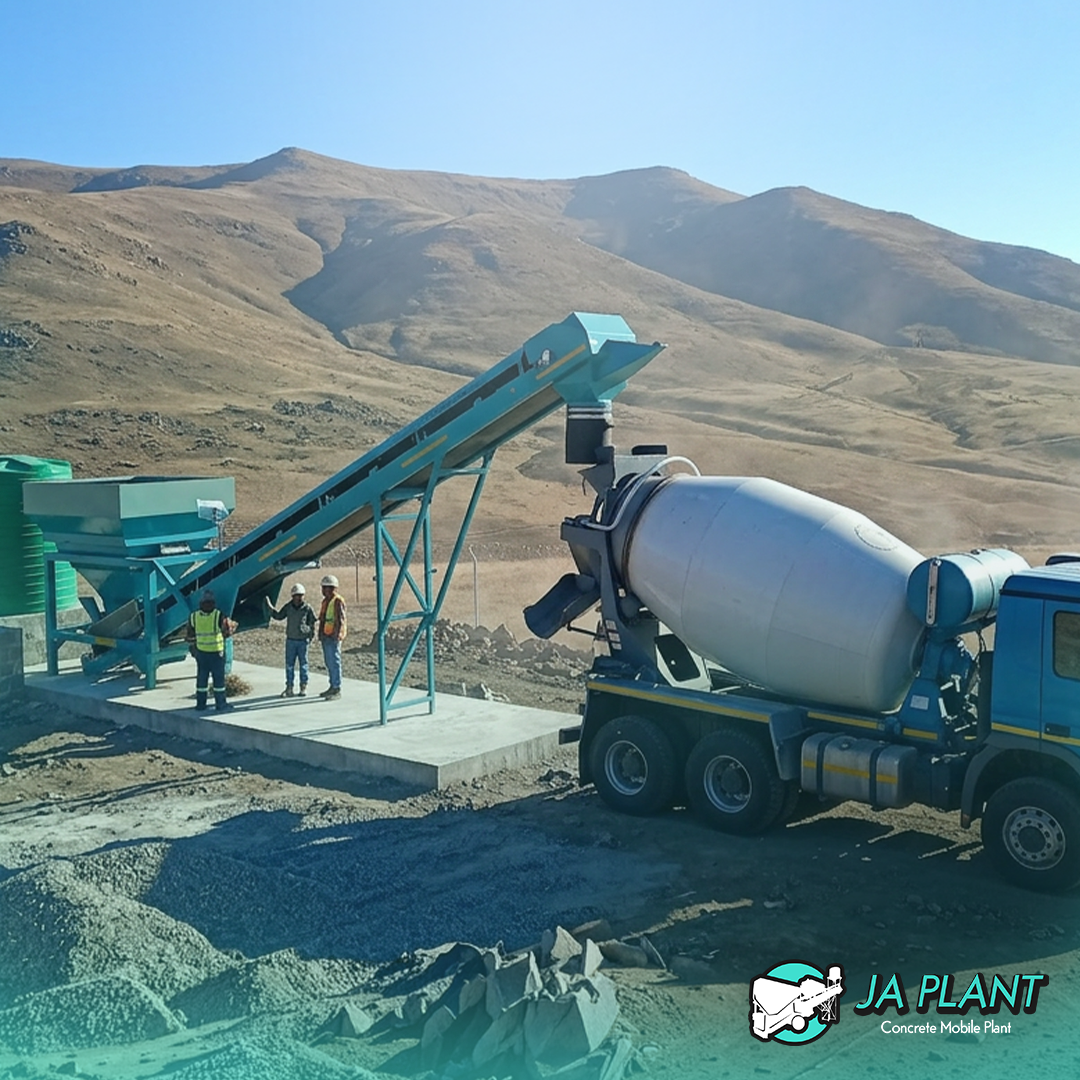
JA Plant's standard mobile concrete batching plants use a dry-batching process. Aggregates, cement and water are measured and loaded into a concrete mixer truck, where the concrete is mixed as the truck travels towards the delivery point. The plant does not replace the mixer truck or discharge fully mixed concrete directly into the pour.
This means site-based batching is still part of ready-mix concrete production. The operational difference is that the contractor can bring batching closer to the work and manage the production sequence rather than depending entirely on an external supplier's dispatch schedule.
A workable setup also requires a front-end loader or TLB, mixer trucks, raw material deliveries, a suitable prepared plant area, water, power and safe vehicle movements. JA Plant's FAQs outline these equipment and site-preparation requirements in more detail.
When should you stay with external ready-mix deliveries?
An external supplier may remain the more practical option when:
-
A dependable supplier is close enough to meet the required pour windows.
-
Concrete is needed only occasionally, rather than in regular batches across the project.
-
Access routes and truck turnaround times are predictable.
-
The project does not justify the equipment, site setup and operating resources required for its own batching operation.
A sensible comparison looks beyond the price per cubic metre. It also considers transport, labour, equipment utilisation, reliability and the cost of disruptions if deliveries do not run to plan.
When is on-site batching worth considering?
Bringing batching onto the project deserves a closer look when:
-
The site has regular or sustained concrete demand over an extended period.
-
Long-distance delivery or repeated truck turnarounds affect the project programme.
-
A suitable batching location and reliable supply of aggregates, cement and water can be arranged.
-
The contractor can operate and maintain the necessary plant, loader and mixer trucks, or has plans to secure them.
A mobile batching plant is not automatically the cheaper or more efficient option. Production requirements, project duration, initial investment, running costs and future plant utilisation all affect the decision.
Which JA Plant batching solution could fit your requirements?
JA Plant manufactures a range of mobile concrete batching plants, including Karoo 30 mobile batching options for contractors with repeated production requirements. Its Echo batching plant is designed for smaller contracts and tighter budgets. The right configuration depends on required hourly output, mixer-truck capacity, site services and material handling needs.
For a closer look at the practical setup requirements, JA Plant's mobile concrete batching plant setup guide explains the equipment and site preparation involved. The company also offers parts, refurbishment, calibration and technical support for ongoing plant operation.
Ask JA Plant which solution suits your site
If external ready-mix deliveries are reliable, accessible and cost-effective, they may remain the right choice. But where long journeys, scheduling restrictions or repeated concrete demand make those deliveries difficult to manage, it is worth assessing whether an on-site batching operation could give the project greater control.
Share your project location, expected concrete volumes, required hourly output, duration, access conditions and available water, power and mixer-truck capacity. JA Plant can help you explore whether a mobile batching plant and an appropriate configuration suit your requirements.
Speak to JA Plant about your on-site batching options.